Beanie Styles Explained: Fitted, Cuffed, Slouchy and Watch Cap
Fitted, cuffed, slouchy and watch cap beanies share one structure and differ mainly in height and brim depth. Here is what defines each style and how to choose between them.
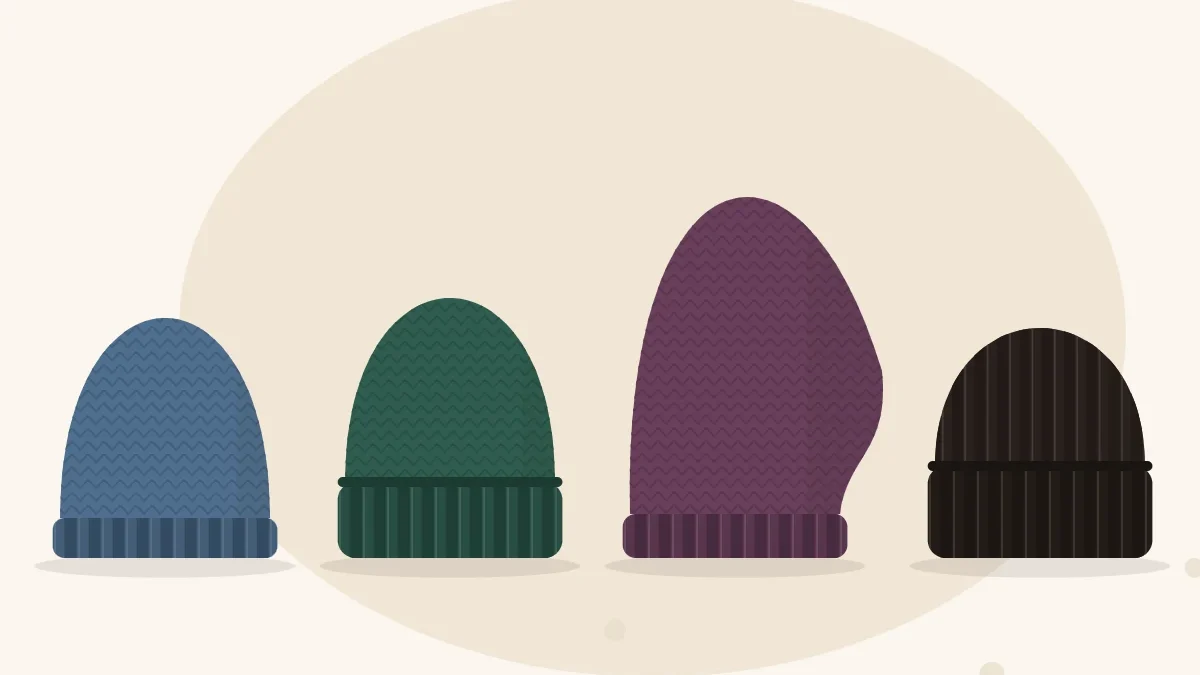
Most beanie styles are the same hat with two numbers changed: how tall the hat is and how deep the brim is. Fitted, cuffed, slouchy and watch cap all start from a tube of knitting with a closed top, sized a little smaller than the head. Knowing which measurement defines each style makes it easy to pick a pattern, or to turn one style into another.
The four styles at a glance
The heights below are typical for an adult hat and are given as guides, not rules. Every head is different, so measure the wearer when the fit matters.
| Style | Typical height, unfolded | Brim | How it sits |
|---|---|---|---|
| Fitted | 8-8.5 in (20-21.5 cm) | Short ribbing, about 1-2 in (2.5-5 cm), worn down | Follows the head closely and ends near the top of the ears or just over them |
| Cuffed | 10-11.5 in (25.5-29 cm) | Ribbing 4-6 in (10-15 cm) deep, folded up once | Fitted on top, with a double layer around the ears |
| Slouchy | 10.5-11.5 in (26.5-29 cm) | Snug ribbing, about 2 in (5 cm), worn down | Grips at the brim; extra fabric relaxes at the back |
| Watch cap | 10-11 in (25.5-28 cm) | Deep fold, usually part of an all-over rib | Close and stretchy from edge to crown, cuff worn snug |
Fitted beanie
The fitted beanie is the baseline. It is just tall enough to reach from the tip of the crown to the ears, with a short band of ribbing to hold the edge in place. Because nothing is folded and nothing hangs, the height has to be right: a fitted hat that is 1 in (2.5 cm) too short rides up, and one that is 1 in too long forms a small empty peak on top.
This is the style most first patterns teach. It uses the least yarn of the four and is the quickest to finish.
Choose it when: the hat goes under a hood or helmet, the yarn is limited, or the knitter wants the simplest possible project.
Cuffed beanie
A cuffed beanie is a fitted beanie with a longer brim that folds up. The fold doubles the fabric over the ears and forehead, which is where a hat does most of its work in cold weather, and it also makes the fit adjustable: unfold the cuff a little for more coverage, fold it deeper for less.
The rule for knitting one is simple. The ribbing must be twice the depth of the cuff you want to see, and the total height grows by the depth of that cuff. A 2 in (5 cm) cuff needs 4 in (10 cm) of ribbing. The classic knit beanie pattern is built exactly this way.

Tip
Ribbing looks the same on both sides, which is why it is the usual choice for a folded cuff. A stockinette brim would show its bumpy purl side when turned up.
Slouchy beanie
A slouchy beanie keeps the snug brim and adds 2 to 3 in (5 to 7.5 cm) of body. The extra length has nowhere to sit, so it collapses toward the back of the head. Two details separate a good slouchy hat from a hat that is merely too big:
- The brim is firm. All of the hold comes from the ribbing, so it is knit on a smaller needle and is never loose.
- The fabric drapes. Soft, fluid yarns fold nicely. Stiff yarns stand up in a point.
The slouchy beanie pattern for beginners shows that no extra stitches are needed, only extra rounds.
Choose it when: the wearer has a lot of hair to fit inside, or prefers a relaxed look to a close one.
Watch cap
The watch cap is the plain, close-fitting, deeply cuffed hat associated with sailors standing watch on deck, and it has long been a standard piece of working knitwear. Hand-knitted caps have a very long past; the Victoria and Albert Museum’s history of hand-knitting gives a sense of how old the craft of knitting everyday garments is.
In knitting terms, what sets a watch cap apart from a cuffed beanie is the fabric. A watch cap is usually ribbed from the cast-on edge to the start of the crown, not only at the brim. All-over ribbing pulls in strongly and stretches a long way, so one size fits a wide range of heads and the hat clings instead of perching. The 1×1 ribbed watch cap pattern is a typical example.
Choose it when: the hat is a gift and the head size is a guess, or the wearer wants a hat that stays put in wind.
How to choose a style
By the person wearing it
- Size unknown: watch cap first, cuffed beanie second. Ribbing and an adjustable fold both forgive a wrong guess.
- Long or thick hair: slouchy.
- Ears that get cold: cuffed or watch cap, for the double layer.
- Growing child: cuffed. Unfolding the brim adds wearable length as the head grows.
By the knitter
- First hat ever: fitted. Fewest rounds, fewest decisions.
- Dislikes purling: fitted or slouchy, where only the brim is ribbed.
- Short on yarn: fitted. Cuffed and slouchy hats need noticeably more.
Turning one style into another
Because the styles share a structure, a pattern for one can be adapted with length alone. Keep the cast-on number and the crown exactly as written, and change only the measurements before the crown.
| From fitted to | Change the ribbing | Change the length before the crown |
|---|---|---|
| Cuffed | Knit it twice the cuff depth | Add the cuff depth |
| Slouchy | Keep it about 2 in (5 cm), on a smaller needle | Add 2-3 in (5-7.5 cm) |
| Watch cap | Continue it all the way up the body | Add the cuff depth; recheck gauge in ribbing |
Watch out
Ribbing and stockinette do not share a gauge. Converting a stockinette hat to all-over ribbing changes the finished width, so swatch in the ribbing before trusting the original stitch count.
Circumference does not change with style. Whatever the shape, the hat should measure roughly 1.5 to 3 in (4 to 7.5 cm) less around than the head. The knit hat size chart lists typical head sizes and hat heights by age, and the Craft Yarn Council head circumference chart is a useful second reference. The edge itself offers further choices, compared in the guide to hat brim styles.
Frequently asked questions
What is the difference between a beanie and a watch cap?
A watch cap is a kind of beanie. It is close-fitting with a deep folded cuff and is usually ribbed from the edge to the crown, which makes it very stretchy. Many other beanies are ribbed only at the brim.
How tall should a cuffed beanie be?
Take the fitted height, typically about 8 to 8.5 in (20 to 21.5 cm) for an adult, and add the depth of the cuff. A 2 in (5 cm) cuff gives an unfolded height of roughly 10 to 10.5 in (25.5 to 26.5 cm).
Which beanie style is easiest for a beginner to knit?
A fitted beanie. It has the fewest rounds and only a short band of ribbing, so it is the quickest style to finish and uses the least yarn.
Does a slouchy beanie need a bigger circumference?
No. The brim should fit as snugly as on a fitted hat. The slouch comes from extra height, usually 2 to 3 in (5 to 7.5 cm), and from a yarn that drapes.