Gauge Swatch for Hats: How to Knit It, Measure It and Use It
A small swatch tells you how many stitches fit in one inch of your knitting, and that number decides whether a hat fits. Here is how to knit, wash, measure and use one.
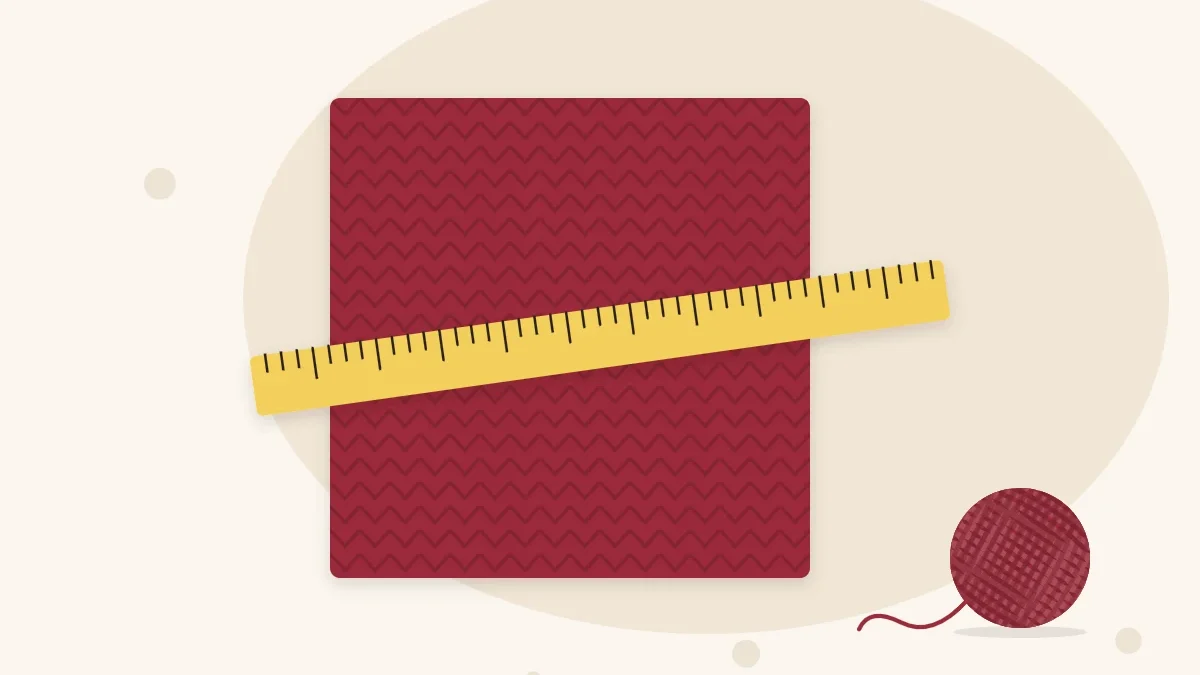
A gauge swatch is a small test square that tells you how many stitches and rounds fit into one inch of your own knitting. For a hat it matters more than for almost any other small project, because half a stitch per inch is the difference between a hat that fits and one that slips over the eyes. The swatch is a small job, usually finished in a single sitting, and it uses very little yarn.
Why gauge decides hat size
A pattern’s size is nothing more than a stitch count divided by a gauge. Take a hat with 88 stitches. At the pattern gauge of 18 stitches to 4 in (10 cm), which is 4.5 stitches per inch, it measures about 19.5 in (49.5 cm) around. Now see what happens when the same 88 stitches are knit at a slightly different tension.
| Stitches in 4 in (10 cm) | Stitches per inch | 88 stitches measure | Result |
|---|---|---|---|
| 16 | 4 | 22 in (56 cm) | No negative ease on a 22 in head; the hat slides down |
| 18 | 4.5 | About 19.5 in (49.5 cm) | As designed |
| 20 | 5 | About 17.5 in (44.5 cm) | Child-sized; tight on an adult |
Two stitches of difference across four inches moved the hat by about two inches or more in either direction. Nobody knits to exactly the same tension as a pattern writer, and the needle size printed on a yarn label is only a suggestion. The swatch is how you find your own number.
How to knit a swatch for a hat
What to use
Use the same yarn, the same needles and the same stitch pattern as the body of the hat. Even the needle material counts: many knitters work more tightly on slick metal needles than on bamboo or wood. If the yarn choice is still open, the guide to the best yarn for knitted hats covers how fiber and weight affect the fabric.
The flat swatch
This is the quick version, suitable for a first hat.
- Cast on enough stitches for about 6 in (15 cm). In worsted weight (4) yarn at 4.5 stitches per inch, that is 28 stitches.
- Knit 4 rows so the bottom edge lies flat.
- Work in stockinette, knitting the right-side rows and purling the wrong-side rows, but knit the first 3 and last 3 stitches of every row. Those garter edges stop the sides from curling.
- Continue until the piece is about 5 in (12.5 cm) tall, knit 4 rows and bind off loosely.
The in-the-round swatch
Most hats are knit in the round, where every round is knit and nothing is purled. Many knitters purl a little more loosely than they knit, so their flat gauge and their circular gauge differ. To copy circular knitting without casting on a whole tube, use a circular or double-pointed needle:
- Cast on the same 28 stitches and knit one row.
- Do not turn the work. Slide the stitches back to the other tip of the needle.
- Carry the working yarn loosely across the back, leaving a long strand, and knit the row again from the right side.
- Repeat until the swatch is about 5 in (12.5 cm) tall, then bind off.
Every row has been knit from the right side, exactly as it will be in the hat. The strands across the back must be long enough for the swatch to lie flat; cut them if necessary before measuring. Ignore the looser stitches at both edges.
Tip
Tie knots in the cast-on tail to record the needle used: six knots for a US 6 (4 mm), eight for a US 8 (5 mm). A swatch found in a project bag months later then explains itself.
Wash it before measuring
Treat the swatch the way the finished hat will be treated. Soak it in cool water for a few minutes, press out the water in a towel without wringing, and lay it flat to dry without stretching or pinning it out hard. Some yarns change noticeably: superwash wool often relaxes and grows when wet, and cotton can lengthen. Measuring an unwashed swatch gives the gauge of a hat that has never been washed, which is not the hat anyone will wear for long.
How to measure gauge
- Lay the dry swatch on a hard, flat surface. Do not smooth it out with your hands.
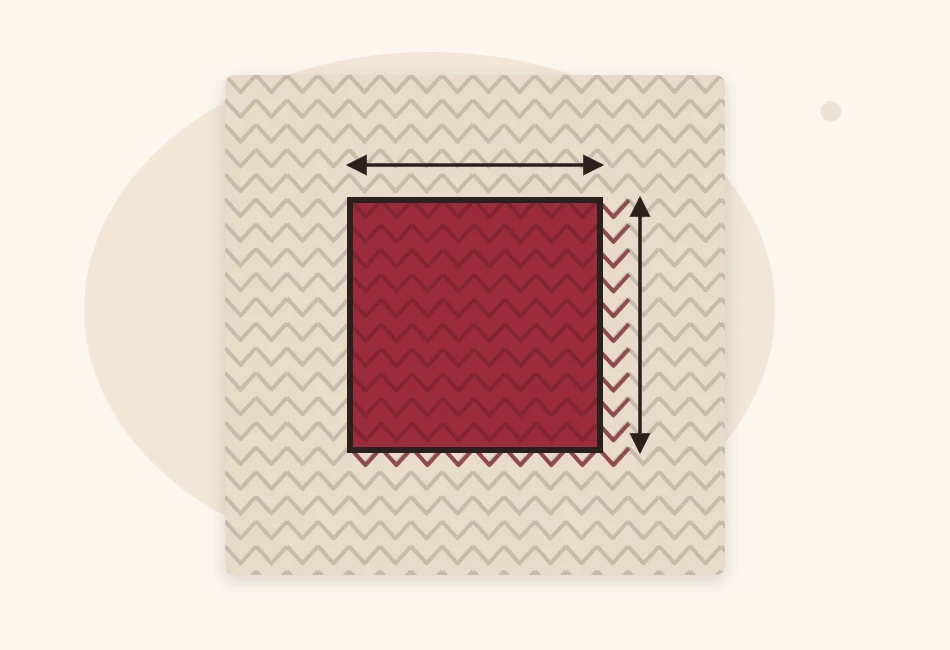
- Place a ruler across the middle, well away from the edges, and mark a 4 in (10 cm) span with two pins.
- Count the stitches between the pins. Each stitch in stockinette looks like a small V. Count half and quarter stitches too.
- Divide by 4 to get stitches per inch. For example, 18 stitches gives 4.5; 19 stitches gives 4.75.
- Turn the ruler upright and count the rows or rounds in 4 in the same way.
- Repeat in a second spot and average the two results.
Watch out
Do not measure across just one inch and multiply. A quarter-stitch error over one inch becomes a full stitch over four, and several stitches around a whole hat.
If your gauge does not match
- Too many stitches in 4 in (for example 20 where the pattern asks for 18): the stitches are too small. Go up one needle size and swatch again.
- Too few stitches in 4 in (for example 16 instead of 18): the stitches are too large. Go down one needle size and swatch again.
- Close, but not exact, and you like the fabric: keep the needles and change the stitch count instead. Multiply your stitches per inch by the hat circumference you want, as explained in how many stitches to cast on for a hat.
Needle sizes run in small steps, and US and metric labels do not always match one to one; the Craft Yarn Council needle size chart shows the next size up or down.
What about row gauge?
Stitch gauge sets the circumference, so match that first. Row or round gauge matters less on a hat because most patterns say “knit until the piece measures” a given height, and a ruler takes care of it. It does affect the crown: with fewer rounds per inch than the pattern, the crown shaping comes out taller. If your rounds are noticeably larger, begin the crown about half an inch (1.5 cm) sooner.
Putting the swatch to work
With stitches per inch in hand, the rest is short arithmetic. Pick a target circumference from the knit hat size chart, multiply it by your gauge and round to a number that suits the pattern. A good first pattern to try it on is the classic knit beanie, which is written for the 4.5 stitches per inch used in the examples above.
Keep the swatch until the hat is finished. If the yarn runs short, it can be unraveled for the last few rounds; if not, it is a ready-made test piece for trying how the fabric washes.
Frequently asked questions
Do I really need a gauge swatch for a hat?
It is strongly recommended. A difference of two stitches over 4 in (10 cm) can change an adult hat by more than 2 in (5 cm) around, which is enough to make it too loose or too tight.
How big should a gauge swatch be?
About 6 in (15 cm) wide and 5 in (12.5 cm) tall, so that a full 4 in (10 cm) can be measured in the middle, away from the uneven edge stitches.
Should I swatch flat or in the round for a hat?
A flat swatch is fine for a first hat. If you purl more loosely than you knit, a swatch worked with every row knit from the right side gives a closer match to a hat knit in the round.
What do I do if I have too many stitches per inch?
Your stitches are smaller than the pattern expects. Switch to a needle one size larger and knit another swatch, or keep the fabric and recalculate the cast-on from your own gauge.