The Best Stitches for Knitted Hats: Stockinette, Garter, Rib and Seed
Stockinette, garter, ribbing and seed stitch all use only knits and purls, but each makes a different hat fabric. Here is how they stretch, curl and fit.

Four stitch patterns do most of the work in hand-knitted hats: stockinette, garter, ribbing and seed stitch. All four use only knit and purl stitches, so none of them is hard to learn. What changes is how the fabric behaves: how much it stretches, whether the edge curls, how thick it feels and how much yarn it uses. Knowing those differences makes it much easier to choose a pattern, or to understand why a pattern was written the way it was.
The four stitches at a glance
| Stitch | Worked in the round | Worked flat | Stretch across | Edge |
|---|---|---|---|---|
| Stockinette | Knit every round | Knit RS rows, purl WS rows | Moderate | Curls |
| Garter | Knit 1 round, purl 1 round | Knit every row | Moderate across, springy lengthwise | Lies flat |
| Ribbing | Same knits and purls stacked every round | Knit the knits, purl the purls | High | Lies flat, pulls in |
| Seed stitch | Knits and purls swapped every round | Knits and purls swapped every row | Low | Lies flat |
RS means right side (the outside of the hat) and WS means wrong side. If any other shorthand in a pattern is unfamiliar, the Craft Yarn Council keeps a master list of knitting abbreviations.
Stockinette: the smooth default
Stockinette is the fabric of small “V” shapes that most people picture when they think of knitting. In the round it is the simplest stitch there is, because the outside of the tube always faces you: knit every stitch of every round. Worked flat, it needs a purl row on the wrong side.
For hats, stockinette has three strengths. It is fast, it is the thinnest and lightest of the four fabrics, and its smooth surface shows off stripes, colorwork and hand-dyed yarn.
Its weakness is the edge. Stockinette curls toward the knit side at the top and bottom, which is why a stockinette hat almost always starts with a band of ribbing. Left without a band, the edge rolls up into a soft tube. That rolled brim is a legitimate style, but it has to be planned, because the roll uses up about an inch of length. The classic knit beanie pattern shows the usual combination: a ribbed cuff, then a stockinette body.
Garter stitch: squishy and beginner-proof
Garter stitch has horizontal ridges on both sides and looks the same inside and out. Worked flat it is nothing but knit stitches, which makes it the natural first fabric for a new knitter. In the round the rule flips: one knit round, then one purl round, to get the same ridges.
Garter fabric is thick, warm and does not curl, so it needs no separate brim. It is compressed lengthwise: two rows make one ridge, and it takes noticeably more rows to knit an inch of garter than an inch of stockinette. That means a little more yarn and a little more time for the same hat height. Garter also stretches downward with wear, so garter hats are usually knitted slightly short.
The easiest project of all is a flat garter rectangle that is seamed and gathered at the top, as in the garter stitch hat tutorial.
Ribbing: the stretch specialist
Ribbing lines up knit stitches above knit stitches and purl stitches above purl stitches, creating vertical columns. The knit columns come forward and the purl columns sink back, so the fabric folds in on itself like a paper fan. Pull it sideways and it opens up; let go and it springs back.
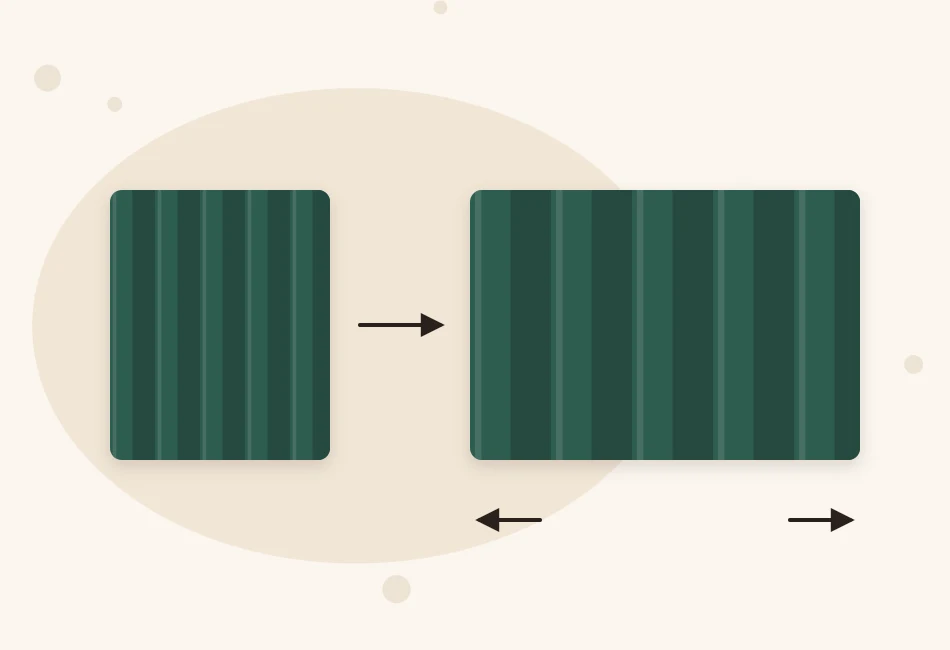
That behavior is exactly what a hat needs at the edge, where the fabric has to stretch over the head and then grip gently above the ears. The two common versions are 1×1 rib (knit 1, purl 1) and 2×2 rib (knit 2, purl 2). Stitch counts matter here: 1×1 rib in the round needs an even number of stitches, and 2×2 rib needs a multiple of 4, so the pattern meets itself neatly at the end of the round.
Ribbing is not only for brims. A hat ribbed from edge to crown fits a wide range of head sizes, which makes it a safe choice for a gift when the head cannot be measured. The 2×2 ribbed beanie is built that way. The trade-offs are speed, since moving the yarn back and forth between knits and purls is slower than plain knitting, and yarn, because the folded fabric needs more stitches to cover the same width.
Seed stitch: texture without curl
Seed stitch uses the same knit 1, purl 1 sequence as 1×1 rib, but the stitches are offset on every round: a knit goes above a purl and a purl above a knit. Instead of columns, the surface becomes an even field of small bumps.
In the round over an even number of stitches, work one round of knit 1, purl 1, then one round of purl 1, knit 1, and keep alternating. The fabric lies flat, looks nearly identical on both sides and is firmer than stockinette, with little sideways stretch. Seed stitch works well as a non-curling brim, as an all-over texture, or as a band across the body. Because it does not pull in the way ribbing does, a seed stitch brim sits flatter and looser against the head. A full walk-through is in the seed stitch hat pattern.
Tip
If seed stitch suddenly turns into ribbing, the rounds have stopped alternating. Look at the stitch below the one about to be worked: if it shows a bump, knit it; if it shows a “V”, purl it.
The same yarn gives a different size in each stitch
Stitch patterns do not share a gauge. With the same yarn and needles, ribbing pulls in and measures narrower than stockinette, garter is shorter row for row, and seed stitch tends to spread slightly wider. Swapping one stitch for another in a pattern therefore changes the finished size, even though the stitch count stays the same.
Watch out
Measure gauge in the stitch the hat body actually uses. A stockinette swatch says little about how wide an all-over ribbed or seed stitch hat will turn out.
The method for knitting and measuring a sample is covered in the guide to making a gauge swatch for hats.
Which stitch for which hat
- For a first hat knitted flat: garter stitch. Every row is the same and the edges behave.
- For a first hat in the round: a ribbed brim with a stockinette body. It is quick and teaches two fabrics in one project.
- For an unknown head size: all-over ribbing, which adapts to the wearer.
- For stripes or colorwork: stockinette, so the color changes stay crisp.
- For plain yarn that needs interest: seed stitch, which adds texture with no new techniques.
- For the warmest fabric from the same yarn: garter or ribbing, which are both thicker than stockinette.
Frequently asked questions
What is the easiest stitch for a knitted hat?
For a hat knitted flat on straight needles, garter stitch is the easiest because every row is knitted. For a hat knitted in the round, stockinette is the easiest because every round is knitted.
Why does the bottom of a stockinette hat curl?
Stockinette fabric naturally rolls toward the knit side at its top and bottom edges. A band of ribbing, garter or seed stitch at the edge stops the curl, or the roll can be kept on purpose as a rolled brim.
Which stitch is the stretchiest for hats?
Ribbing is the stretchiest across its width and springs back after being pulled, which is why it is used for most brims and for hats meant to fit a range of head sizes.
Can one stitch be swapped for another in a hat pattern?
Yes, but the size will change. Each stitch pattern has its own gauge, so knit a swatch in the new stitch and check the stitch count against it before starting.