Seed Stitch Hat: Easy Texture for a First Pattern
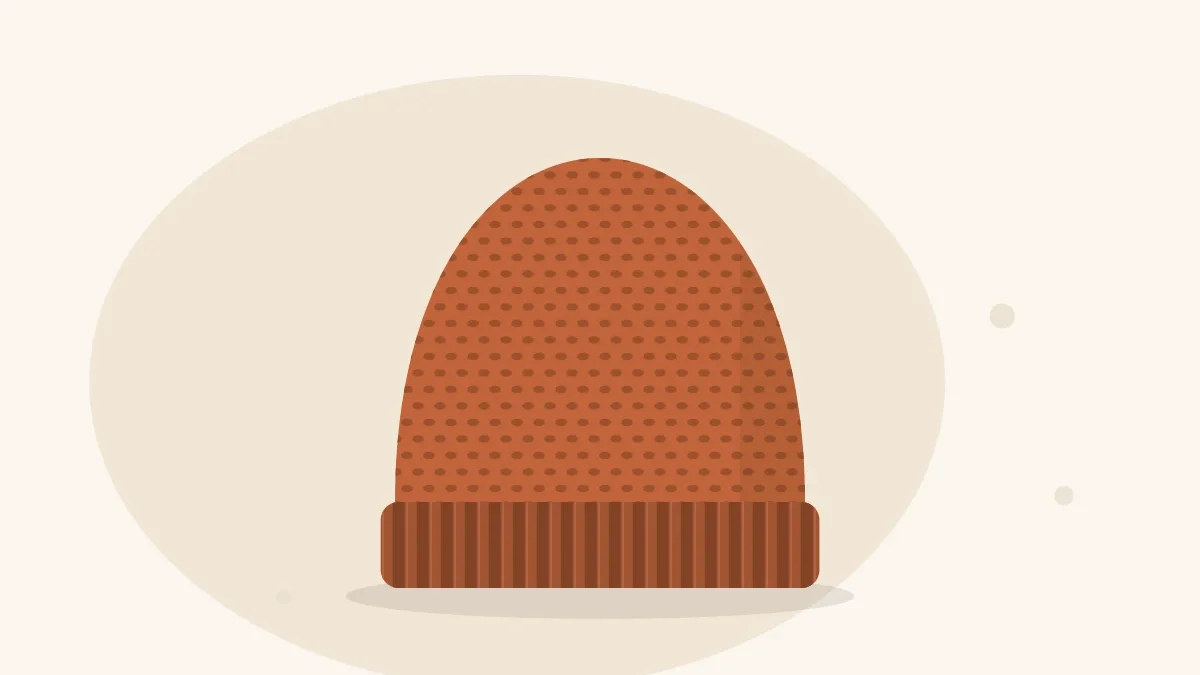
A textured worsted-weight hat with a 1x1 ribbed brim, a seed stitch body and a simple stockinette crown, using only knit, purl and one decrease.
Tutorial at a glance
Materials
- Smooth worsted-weight yarn in a solid color
- US 6 (4 mm) 16-inch circular needle
- US 8 (5 mm) 16-inch circular needle
- US 8 (5 mm) double-pointed needles
- 8 stitch markers
- Tape measure
- Tapestry needle
- Scissors
Seed stitch is made of nothing but knit and purl stitches, alternated so that every knit sits beside and above a purl. The result is a pebbly, reversible fabric that lies flat and hides uneven tension well. This seed stitch hat pairs a textured body with a ribbed brim and a plain stockinette crown, so the only decrease used is worked on easy knit rounds.
How seed stitch works in the round
The rule fits in one line: knit the purls and purl the knits. On an even number of stitches in the round, that takes two rounds.
- Seed rnd 1: (P1, k1) to the end.
- Seed rnd 2: (K1, p1) to the end.
Repeat those two rounds and the texture appears.

Tip
Learn to read the stitch below instead of counting rounds. A stitch with a bump at its base was purled last time, so knit it. A smooth V was knitted, so purl it. With this habit there is no need to remember which round you are on.
How seed stitch compares with other fabrics for stretch and warmth is covered in the guide to the best stitches for knitted hats.
What you need
- Yarn: worsted weight (4), about 165 (180) yd (151 (165) m). Seed stitch tends to use more yarn than stockinette for the same area, and these amounts are estimates, so buy a little extra. A smooth, round, solid-colored yarn shows the texture best; fuzzy or strongly variegated yarns hide it.
- Needles: US 6 (4 mm) 16-inch circular for the brim; US 8 (5 mm) 16-inch circular for the body; US 8 (5 mm) double-pointed needles (DPNs) for the crown. Other ways to handle the small rounds at the top are compared in needles for knitting hats.
- Notions: 8 stitch markers (one distinct), tape measure, tapestry needle, scissors.
Gauge and finished size
Gauge: 18 sts and 28 rnds = 4 in (10 cm) in seed stitch on the US 8 (5 mm) needle, or 4.5 stitches per inch. Seed stitch rounds are shorter than stockinette rounds, so swatch in seed stitch itself. To swatch flat on an even number of stitches, work row 1 as (K1, p1) and row 2 as (P1, k1). The guide to a gauge swatch for hats explains how to measure it. If you get more than 18 sts in 4 in, use a larger needle; if fewer, a smaller one.
| Size M | Size L | |
|---|---|---|
| Cast on | 88 sts | 96 sts |
| Finished circumference | 19.5 in (49.5 cm) | 21.25 in (54 cm) |
| Typical head it fits | 21-22.5 in (53.5-57 cm) | 23-24 in (58.5-61 cm) |
| Finished height | about 8.25 in (21 cm) | about 8.5 in (21.5 cm) |
The head measurements are typical ranges; measure the wearer to be sure. Instructions are written M (L).
Abbreviations
All are standard terms from the Craft Yarn Council abbreviations list.
- CO: cast on
- k: knit
- p: purl
- k2tog: knit 2 stitches together
- st/sts: stitch/stitches
- rnd: round
- pm: place marker
- BOR: beginning of round
The pattern
Brim
- With the US 6 (4 mm) circular needle, CO 88 (96) sts using a stretchy cast-on.
- Pm for BOR and join to work in the round, checking first that the stitches are not twisted around the needle.
- Rib rnd: (K1, p1) to the end. Repeat until the brim measures 1.5 in (4 cm).
Seed stitch body
- Change to the US 8 (5 mm) circular needle.
- Seed rnd 1: (P1, k1) to the end. Each purl now sits on top of a knit rib and each knit on top of a purl, so the texture starts at once.
- Seed rnd 2: (K1, p1) to the end.
- Repeat seed rnds 1 and 2 until the piece measures 5.75 in (14.5 cm) from the cast-on edge, ending after any rnd. That is 4.25 in (11 cm) of seed stitch, or about 30 rnds at this gauge.
Crown
The crown is worked in stockinette: knit every stitch that is not part of a decrease. This keeps the shaping simple, since decreasing inside seed stitch means deciding at each k2tog whether to knit or purl. Stockinette rounds are a little taller, about 6 to the inch at this gauge. Place a marker after every 11 (12) sts on the first crown rnd, with the BOR marker as the eighth, and change to DPNs when the circular needle becomes too long.
- Size L only: (K10, k2tog) 8 times — 88 sts. Knit 1 rnd.
- Both sizes: (K9, k2tog) 8 times — 80 sts. Knit 1 rnd.
- (K8, k2tog) 8 times — 72 sts. Knit 1 rnd.
- (K7, k2tog) 8 times — 64 sts. Knit 1 rnd.
- (K6, k2tog) 8 times — 56 sts. Knit 1 rnd.
- (K5, k2tog) 8 times — 48 sts. Knit 1 rnd.
- (K4, k2tog) 8 times — 40 sts.
- (K3, k2tog) 8 times — 32 sts.
- (K2, k2tog) 8 times — 24 sts.
- (K1, k2tog) 8 times — 16 sts.
- K2tog 8 times — 8 sts.
The crown is 15 (17) rnds and adds roughly 2.5 (2.75) in (6.5 (7) cm).
Finishing
Cut the yarn with an 8 in (20 cm) tail, run it through the 8 remaining sts with a tapestry needle and pull the top closed. Weave in both tails on the inside; in seed stitch, following the path of the purl bumps hides an end almost completely. Block gently and avoid pressing the fabric flat, which dulls the texture. Each step is described in how to finish a knit hat.
If the texture goes wrong
| What you see | What happened | What to do |
|---|---|---|
| Vertical columns, like ribbing | The same seed rnd was worked twice | Undo back to the last correct rnd, then knit the purls and purl the knits |
| Two knits or two purls side by side | A stitch was missed, or the stitch count became odd | Count the stitches; correct the single stitch on the next rnd |
Watch out
Move the yarn between the needle tips, never over the top of the needle, when switching between knit and purl. Carrying it over the needle creates an extra loop, and the stitch count grows without warning.
Ways to adjust it
- Folded cuff: work 4 in (10 cm) of ribbing and begin the crown at 8.25 in (21 cm) from the cast-on edge. Allow roughly 35 yd (32 m) more yarn.
- Different size: any multiple of 8 keeps both the stitch pattern and the 8 crown sections intact; the method for choosing the number is in how many stitches to cast on for a hat.
Frequently asked questions
How do you knit seed stitch in the round?
On an even number of stitches, work one round of (purl 1, knit 1) and the next round of (knit 1, purl 1), then repeat those two rounds. Every knit ends up above a purl and every purl above a knit.
What is the difference between seed stitch and 1x1 ribbing?
Both alternate knit and purl stitches. In ribbing the knits and purls stack in vertical columns; in seed stitch they are offset every round, which makes a flat, pebbly fabric that does not pull in the way ribbing does.
Does seed stitch use more yarn than stockinette?
It tends to, because the rounds are shorter and more of them are needed for the same height. Allow a little extra yarn when planning a seed stitch hat.
Why is the crown knit in stockinette instead of seed stitch?
Decreasing in seed stitch interrupts the knit-purl sequence and takes some care to keep neat. A stockinette crown keeps the shaping simple for a first textured hat.