Simple Colorwork Hat: A First Two-Color Band
A plain worsted-weight beanie with one small stranded band above the brim: a 4-stitch, 7-round chart with short floats, written out round by round for a first try at colorwork.

Tutorial at a glance
Materials
- Worsted-weight wool in a main color
- Worsted-weight wool in a contrast color
- US 6 (4 mm) 16-inch circular needle
- US 8 (5 mm) 16-inch circular needle
- US 8 (5 mm) double-pointed needles
- 8 stitch markers
- Tape measure
- Tapestry needle
- Scissors
Stranded colorwork means knitting with two colors in the same round and carrying the unused one loosely across the back. It looks intricate, but a first attempt can be very small. This simple colorwork hat is a plain worsted-weight beanie with one 7-round band above the brim, built on a 4-stitch repeat in which no strand ever crosses more than 3 stitches. Only three of the seven rounds use both colors at once.
What you need
- Yarn: worsted weight (4). Main color (MC): about 130 (145) yd (119 (133) m). Contrast color (CC): about 20 yd (18 m). Both figures are estimates, so allow a little extra. Wool with some grip is easier for colorwork than slippery fibers, because the stitches hold their size; yarn weights are defined in the standard yarn weight system.
- Needles: US 6 (4 mm) 16-inch circular for the brim; US 8 (5 mm) 16-inch circular and US 8 (5 mm) double-pointed needles (DPNs) for the body and crown.
- Notions: 8 stitch markers (one distinct), tape measure, tapestry needle, scissors.
Gauge and finished size
Gauge: 18 sts and 24 rnds = 4 in (10 cm) in plain stockinette on the US 8 (5 mm) needle, which is 4.5 stitches per inch.
| Size M | Size L | |
|---|---|---|
| Cast on | 88 sts (22 chart repeats) | 96 sts (24 chart repeats) |
| Finished circumference | 19.5 in (49.5 cm) | 21.25 in (54 cm) |
| Typical head it fits | 21-22.5 in (53.5-57 cm) | 23-24 in (58.5-61 cm) |
| Finished height | about 8.25 in (21 cm) | about 8.5 in (21.5 cm) |
Head ranges are typical, so measure the wearer. Instructions are written M (L).
Watch out
Stranded fabric is usually tighter and less stretchy than plain stockinette. If your gauge swatch pulls in across the two-color rounds, work the 7 band rounds on a US 9 (5.5 mm) needle and return to US 8 (5 mm) afterward.
Abbreviations
MC: main color. CC: contrast color. CO: cast on. k: knit. p: purl. k2tog: knit 2 stitches together. st/sts: stitch/stitches. rnd: round. pm: place marker. BOR: beginning of round.
Reading the chart
A colorwork chart is a picture of the fabric seen from the right side. Each square is one stitch and each row of squares is one round. When knitting in the round, every chart row is read from right to left, starting with the bottom row, and the repeat is worked over and over until the round ends. General chart conventions are covered in the Craft Yarn Council guide to reading a knitting pattern and in this site’s guide on how to read a hat pattern.
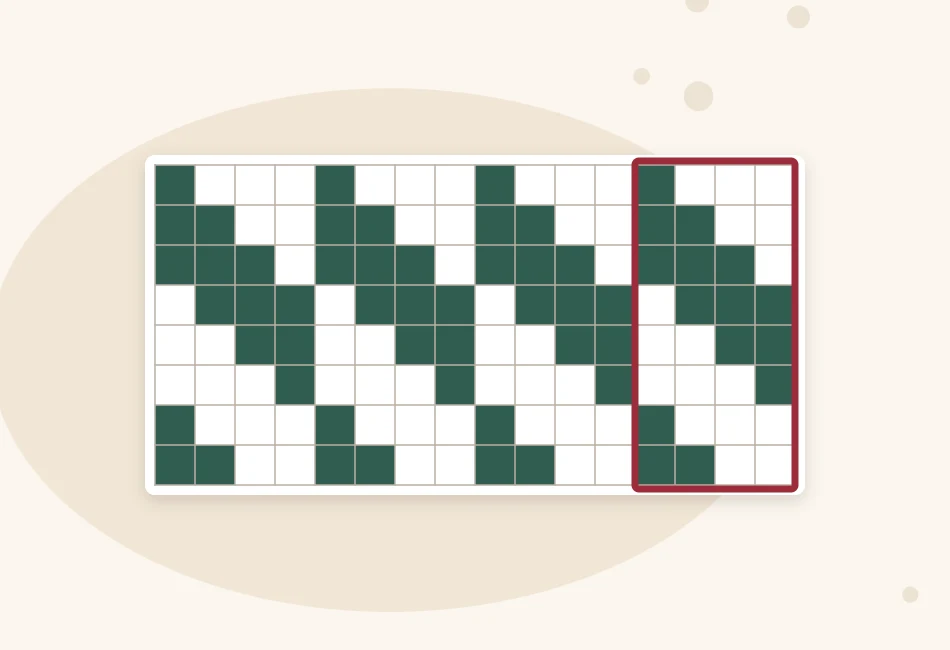
The same chart in words, with stitch 1 being the first stitch knit in each repeat:
| Band rnd | Stitch 1 | Stitch 2 | Stitch 3 | Stitch 4 | Written out |
|---|---|---|---|---|---|
| 1 | CC | CC | CC | CC | Knit all sts in CC |
| 2 | MC | MC | MC | MC | Knit all sts in MC |
| 3 | CC | MC | MC | MC | (K1 CC, k3 MC) to end |
| 4 | CC | CC | MC | CC | (K2 CC, k1 MC, k1 CC) to end |
| 5 | CC | MC | MC | MC | (K1 CC, k3 MC) to end |
| 6 | MC | MC | MC | MC | Knit all sts in MC |
| 7 | CC | CC | CC | CC | Knit all sts in CC |
Each repeat uses 4 sts, so the round works out evenly: 22 (24) repeats.
Managing the floats
The strand of unused yarn lying across the back is called a float. Floats decide whether colorwork lies flat or puckers.

- Spread the stitches. Before knitting with a color that has been waiting, stretch the stitches just worked along the right needle to their natural width. The float then matches the width of the fabric.
- Keep the colors in the same order. Always pick up CC from below MC, or always from above. Swapping makes the pattern stitches change size from round to round.
- Do not twist at every stitch. With floats of 3 sts or fewer, nothing needs to be caught or wrapped.
The pattern
- Brim: with MC and the US 6 (4 mm) circular needle, CO 88 (96) sts. Pm for BOR and join to work in the round without twisting. Work (K2, p2) to the end of every rnd until the brim measures 1.5 in (4 cm).
- Set-up: change to the US 8 (5 mm) circular needle. With MC, knit 3 rnds.
- Band: join CC, leaving a 6 in (15 cm) tail, and work band rnds 1 to 7 from the chart or the table. On the single-color rnds, let the other yarn hang at the BOR and pick it up again when needed. After rnd 7, cut CC, leaving a 6 in (15 cm) tail.
- Body: with MC, knit every rnd until the piece measures 5.75 in (14.5 cm) from the cast-on edge. On the last rnd, place a marker after every 11 (12) sts, using the BOR marker as the eighth.
- Crown, size L only: (K10, k2tog) 8 times — 88 sts. Knit 1 rnd.
- Crown, both sizes: (K9, k2tog) 8 times — 80 sts. Knit 1 rnd.
- (K8, k2tog) 8 times — 72 sts. Knit 1 rnd.
- (K7, k2tog) 8 times — 64 sts. Knit 1 rnd.
- (K6, k2tog) 8 times — 56 sts. Knit 1 rnd.
- (K5, k2tog) 8 times — 48 sts. Knit 1 rnd.
- (K4, k2tog) 8 times — 40 sts.
- (K3, k2tog) 8 times — 32 sts.
- (K2, k2tog) 8 times — 24 sts.
- (K1, k2tog) 8 times — 16 sts.
- K2tog 8 times — 8 sts.
Change to DPNs when the stitches no longer reach around the circular needle. The crown takes 15 (17) rnds, about 2.5 (2.75) in (6.5 (7) cm); the logic behind the spacing is explained in the guide to crown decreases.
Finishing
Cut MC with an 8 in (20 cm) tail, thread it through the 8 remaining sts and pull closed. Weave the two CC tails into the backs of CC stitches so they do not show on the right side. Then block: stranded knitting evens out noticeably once it has been wet and dried flat. See how to finish a knit hat for each step.
Ways to adjust it
- Smaller size: CO 80 sts (20 repeats, about 17.75 in / 45 cm) and begin the crown at “(K8, k2tog) 8 times — 72 sts” when the piece measures 5.5 in (14 cm).
- Two bands: knit 3 rnds in MC after the first band, then work the 7 band rnds again. Allow roughly 15 yd (14 m) more CC.
- Simpler band: leave out band rnds 1 and 7 for a row of small diamonds with no solid lines.
If two colors in one round feels like too much for now, a striped knit hat practices color changes with only one yarn in hand at a time.
Frequently asked questions
What is a float in colorwork knitting?
A float is the strand of unused yarn that travels across the back of the fabric while the other color is being knit. In this hat no float crosses more than 3 stitches, so none of them need to be caught.
Why does my colorwork pucker?
The floats are too tight. Spread the stitches on the right needle to their natural width before knitting with the color that has been waiting, and consider a needle one size larger for the two-color rounds.
Why must the cast-on be a multiple of 4?
The chart repeats every 4 stitches. If the stitch count is not a multiple of 4, the last repeat of the round is cut short and the pattern does not line up at the beginning of the round.
Do I read the chart left to right or right to left?
When knitting in the round, read every chart row from right to left, starting at the bottom row and working upward, because every round is knit in the same direction on the right side.