How to Read a Hat Knitting Pattern: Abbreviations, Repeats and Rounds
A plain-language walk through a hat knitting pattern: the information block, sizes in parentheses, abbreviations, repeats, stitch counts and charts.
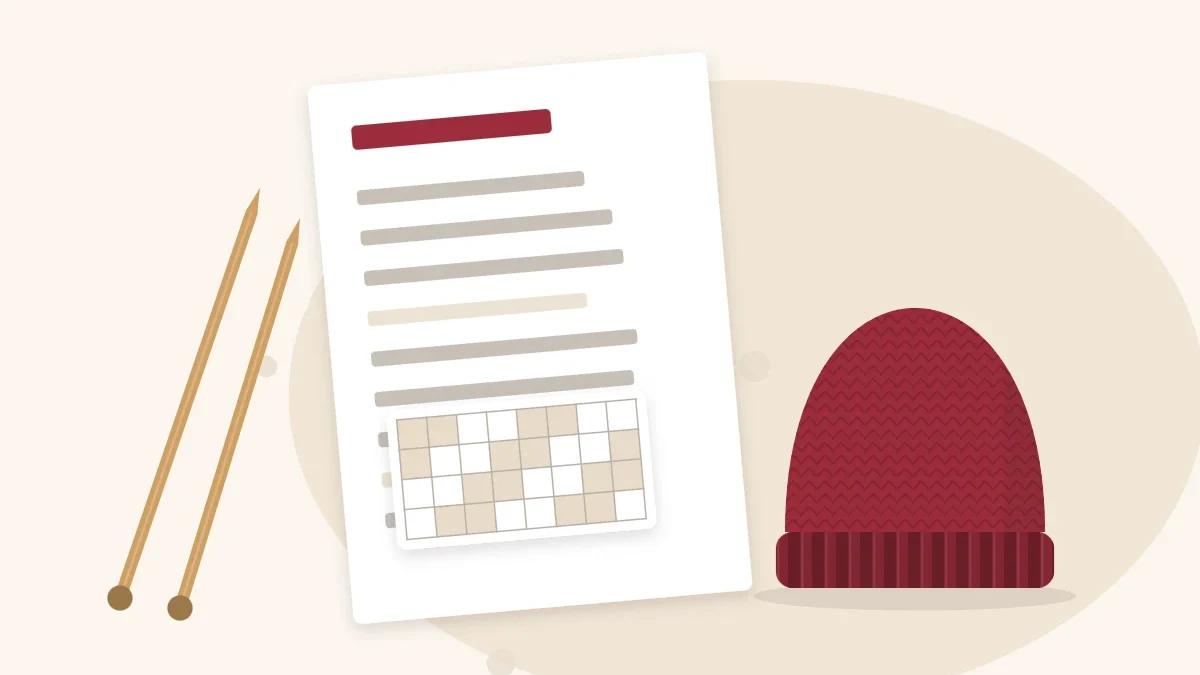
A hat knitting pattern is a compressed set of instructions: a block of facts at the top, then a short series of lines full of abbreviations, parentheses and stitch counts. Once the conventions are familiar, the same handful of ideas appears in nearly every pattern. This guide walks through a hat pattern in the order it is normally printed and explains what each part is asking for.
Start with the information block
Before any stitches, a pattern lists what the hat is and what it needs. Read this part slowly, because it decides whether the finished hat fits.
- Sizes and finished measurements. The finished circumference is the size of the hat itself, not the head. Hats are normally knitted 1.5 to 3 in (4 to 7.5 cm) smaller than the head so they stay on. Measure the head and compare it with a knit hat size chart before choosing a size.
- Yarn. Look for the weight (for example worsted weight, number 4) and the approximate yardage. Yardage is an estimate, so buy a little extra.
- Needles. Hats in the round usually list a 16-inch circular needle plus double-pointed needles for the crown, and often a smaller size for the brim.
- Gauge. Written as stitches and rounds over 4 in (10 cm), such as “18 sts and 24 rnds = 4 in in stockinette.” Gauge is the link between stitch count and size: 88 stitches at 4.5 stitches per inch make a hat about 19.5 in (49.5 cm) around. A different gauge makes a different hat. The guide to knitting a gauge swatch for hats explains how to check it.
- Notions. Stitch marker, tapestry needle, scissors.
Sizes written in parentheses
Patterns with more than one size put the numbers in a fixed order: the smallest first, the rest in parentheses. If the sizes are listed as Small (Medium, Large), then “CO 80 (88, 96) sts” means cast on 80 for small, 88 for medium or 96 for large. That order never changes inside the pattern.
When only one number appears, it applies to every size. When a line says “Size Large only,” the other sizes skip it.
Tip
Before starting, go through a printed copy and circle or highlight the number for the chosen size on every line. It prevents the most common multi-size mistake: following the small count on one round and the large count on the next.
The abbreviations that matter for hats
Patterns shorten common words to save space. A hat rarely needs more than these:
| Abbreviation | Meaning |
|---|---|
| CO / BO | Cast on / bind off |
| k / p | Knit / purl |
| st, sts | Stitch, stitches |
| rnd, rnds | Round, rounds |
| pm / sm | Place marker / slip marker |
| BOR | Beginning of round |
| k2tog | Knit 2 stitches together (a decrease that leans right) |
| ssk | Slip, slip, knit (a decrease that leans left) |
| RS / WS | Right side / wrong side of the fabric |
| MC / CC | Main color / contrast color |
A number after a letter is a count: “k9” means knit nine stitches. A good pattern defines its own abbreviations. For anything it leaves out, the Craft Yarn Council publishes a master list of knitting abbreviations.
Repeats: asterisks, parentheses and “to end”
Most hat rounds are one short sequence worked over and over. Patterns show this in two ways.
Asterisks. “*K2, p2; rep from * to end” means work knit 2, purl 2, then go back to the asterisk and do it again, all the way around the hat.
Parentheses or brackets with a number. “(K9, k2tog) 8 times” means work everything inside the parentheses eight times in a row.
A few short phrases turn up alongside the repeats:
- Work even: continue in the current stitch pattern with no increases or decreases.
- As established: keep doing what the previous rounds set up, such as knitting the knit stitches and purling the purl stitches.
- Until piece measures 6 in from cast-on edge: lay the hat flat and measure straight up from the bottom edge, without stretching.
Rounds, rows and the marker
A hat knitted in the round is worked in rounds, and the outside of the hat faces the knitter the whole time. A marker placed at the join shows the beginning of the round (BOR); slip it from the left needle to the right each time it comes up. Stockinette in the round is simply “knit every round.”
A hat knitted flat on straight needles is worked in rows that go back and forth, and the pattern will label rows RS or WS. The same stockinette fabric then needs a knit row followed by a purl row.
Stitch counts are a built-in check
After any round that changes the number of stitches, a pattern usually gives the new total after a dash or in brackets. Take this crown round on a hat of 88 stitches:
(K9, k2tog) 8 times — 80 sts.
Each repeat uses 11 stitches (9 knitted plus 2 knitted together) and leaves 10 on the needle. Eight repeats use 8 x 11 = 88 stitches and leave 8 x 10 = 80. If the repeat does not come out even at the marker, or a count afterwards does not give 80, something went wrong in that round, and it is far easier to fix now than three rounds later. The reasoning behind these rounds is explained in the guide to crown decreases.
Reading a chart
Colorwork and textured hats often replace written rounds with a chart. Each square is one stitch and each row of squares is one round. A key explains what the symbols or colors mean.
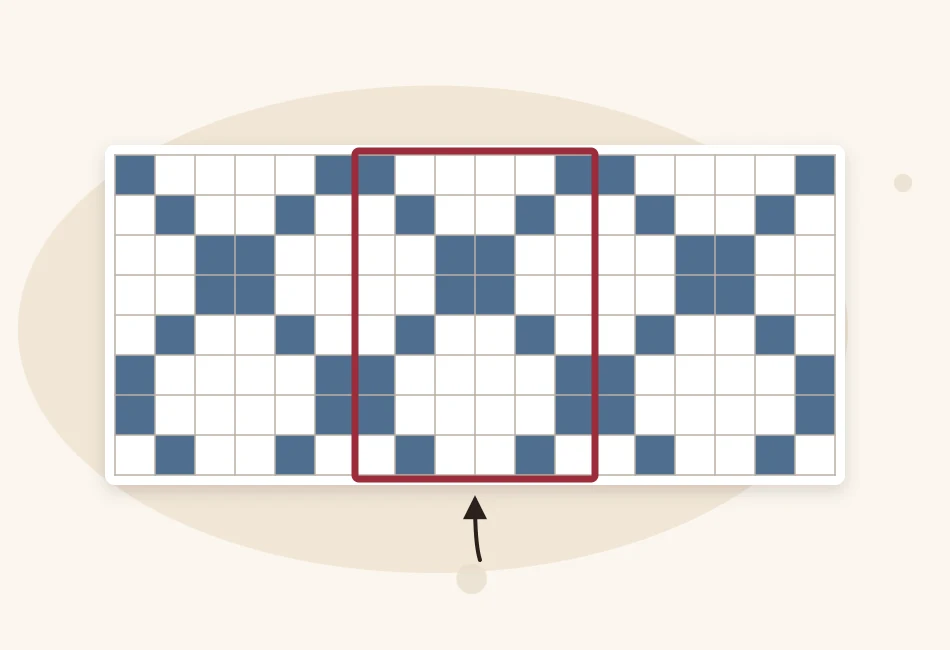
- Start at the bottom right corner and read upward, one row of the chart per round.
- In the round, read every row from right to left, because every round is worked in the same direction.
- Worked flat, read RS rows right to left and WS rows left to right.
- Only one repeat is drawn. A 4-stitch repeat on an 88-stitch hat is worked 22 times per round, which is why the stitch count must divide evenly by the repeat.
A small two-color band, such as the one in the simple colorwork hat, is a gentle first chart.
A two-minute check before casting on
- Read the whole pattern once, start to finish, without yarn in hand.
- Choose a size from the finished circumference and mark its numbers.
- Confirm the yarn weight, yardage and both needle sizes.
- Knit a swatch and compare it with the stated gauge.
- Look up any abbreviation or technique that is new.
- Note where the stitch count changes, so those rounds get a count.
For a broader overview of pattern conventions beyond hats, the Craft Yarn Council’s page on how to read a knitting pattern is a reliable reference. A straightforward pattern to practice on is the classic knit beanie, which uses every convention described here.
Frequently asked questions
What do the numbers in parentheses mean in a knitting pattern?
When they follow a first number, they are the counts for the larger sizes, in the same order as the sizes are listed. When parentheses surround stitches and are followed by a number of times, they mark a sequence to repeat.
What does the asterisk mean in a hat pattern?
An asterisk marks the start of a repeat. "Rep from *" means go back to the asterisk and work that sequence again, usually to the end of the round.
Why does a pattern give a stitch count after some rounds?
The count is the number of stitches that should be on the needle after that round. It lets the knitter confirm a decrease round was worked correctly before moving on.
Which direction is a knitting chart read for a hat in the round?
Start at the bottom right and read every row from right to left, working upward one row per round.