Striped Knit Hat: Simple Color Changes in the Round
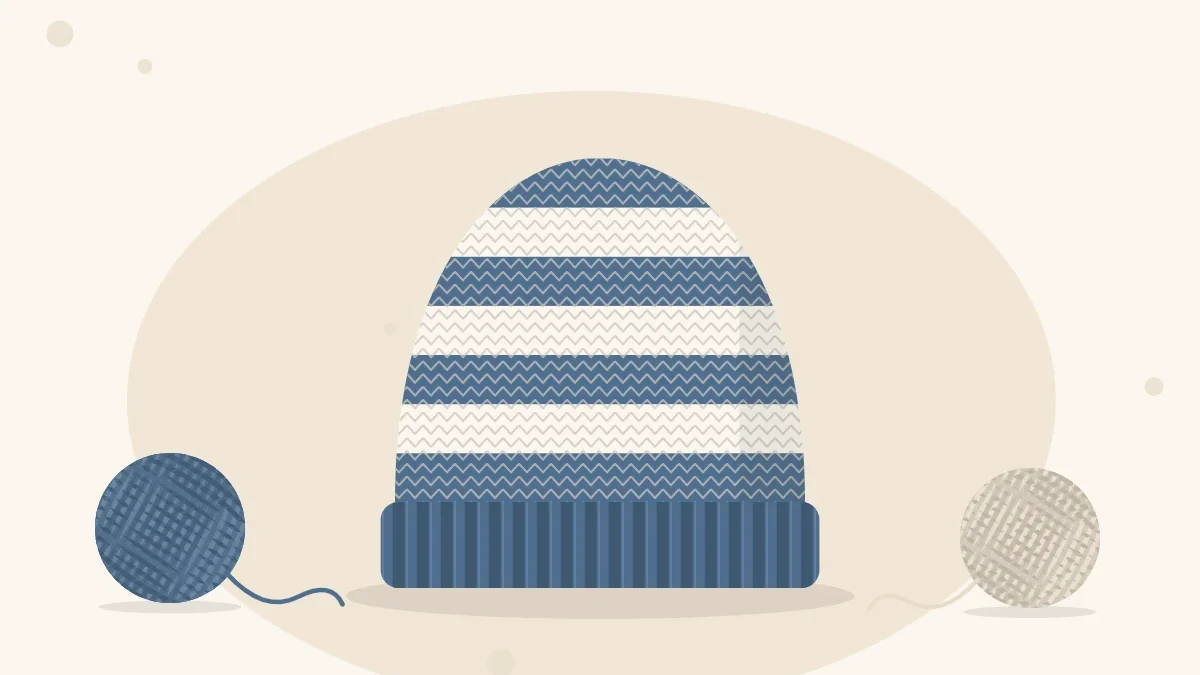
A fitted two-color beanie with even 4-round stripes, plus clear instructions for changing colors, carrying the unused yarn and smoothing the jog where each stripe starts.
Tutorial at a glance
Materials
- Worsted-weight yarn in a main color
- Worsted-weight yarn in a contrast color
- US 6 (4 mm) 16-inch circular needle
- US 8 (5 mm) 16-inch circular needle
- US 8 (5 mm) double-pointed needles
- 8 stitch markers
- Tape measure
- Tapestry needle
- Scissors
Stripes are the easiest way to put two colors in a hat, because only one color is ever in use at a time. You knit a few rounds, drop that yarn, pick up the other and carry on. This striped knit hat is a fitted worsted-weight beanie with even 4-round stripes, and it deals with the two things that trip people up: the small step where each stripe begins, and what to do with the yarn that is waiting its turn.
What you need
- Yarn: worsted weight (4) in two colors. Main color (MC): about 80 (90, 100) yd (73 (82, 91) m). Contrast color (CC): about 60 (65, 75) yd (55 (59, 69) m). These are estimates; allow a little extra of each.
- Needles: US 6 (4 mm) 16-inch circular for the brim; US 8 (5 mm) 16-inch circular and US 8 (5 mm) double-pointed needles (DPNs) for the rest.
- Notions: 8 stitch markers (one distinct), tape measure, tapestry needle, scissors.
Choose two yarns of the same weight and similar fiber so the stripes sit at the same gauge and wash the same way.
Gauge and finished sizes
Gauge: 18 sts and 24 rnds = 4 in (10 cm) in stockinette on the US 8 (5 mm) needle. Round gauge matters more than usual here because the stripes set the height: 4 rnds make a stripe about 0.67 in (1.7 cm) tall. A gauge swatch knit in one of the two colors is enough.
| Size | Cast on | Circumference | Typical head it fits | Height |
|---|---|---|---|---|
| S | 80 sts | 17.75 in (45 cm) | 19.5-20.5 in (49.5-52 cm) | about 7.75 in (19.5 cm) |
| M | 88 sts | 19.5 in (49.5 cm) | 21-22.5 in (53.5-57 cm) | about 8 in (20.5 cm) |
| L | 96 sts | 21.25 in (54 cm) | 23-24 in (58.5-61 cm) | about 8.25 in (21 cm) |
Head ranges are typical; measure the wearer to be sure. Numbers are written S (M, L).
Abbreviations
These follow the Craft Yarn Council abbreviations list.
- MC / CC: main color / contrast color
- CO: cast on
- k / p: knit / purl
- k2tog: knit 2 stitches together
- st/sts: stitch/stitches
- rnd: round
- pm: place marker
- BOR: beginning of round
Two techniques to know first
Changing color and carrying the yarn
At the BOR marker, let the old color hang at the back of the work and begin knitting with the new one, leaving a 6 in (15 cm) tail the first time each color is joined. Do not cut the old yarn. With stripes only 4 rnds tall, the idle color is carried up the inside of the hat to where it is needed next.
To keep that carried strand from forming a long loose loop, catch it once on the way up: at the start of the third rnd of each stripe, lay the idle yarn over the working yarn before knitting the first stitch. Keep the carried strand relaxed, or the fabric puckers.
Smoothing the jog
Knitting in the round is a spiral, not a stack of rings, so the end of each round sits one row higher than its start. With one color nobody can see it. With stripes it shows as a small step, called a jog, at every color change.
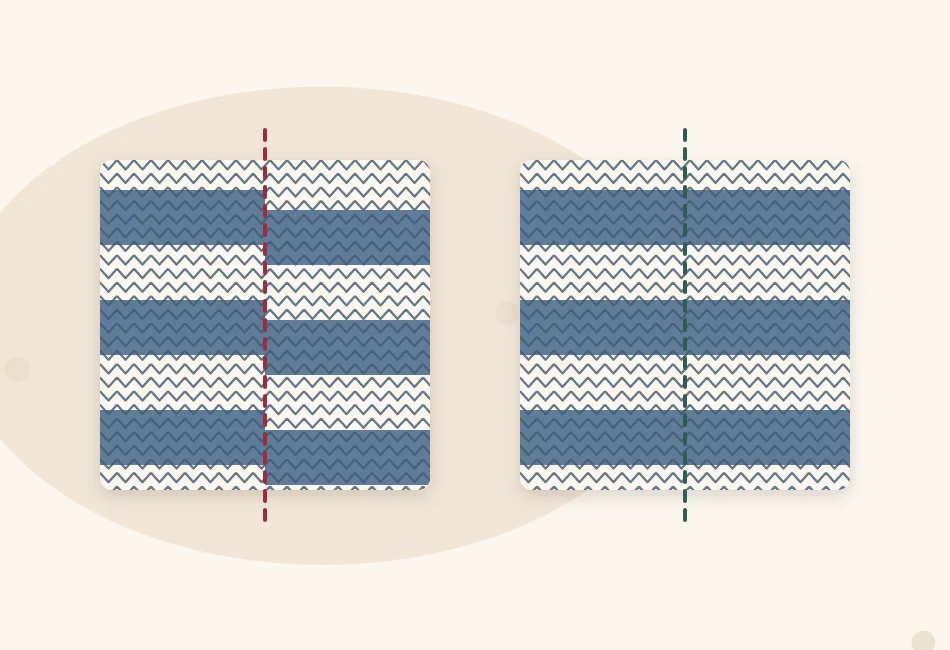
The fix takes one stitch. Knit the first rnd of the new color normally. At the start of the second rnd, slip the first stitch from the left needle to the right needle as if to purl, with the yarn held at the back, without knitting it. Then knit the rest of the rnd as usual. The slipped stitch is pulled up level with its neighbor and the step all but disappears.
The pattern
Brim
- With MC and the US 6 (4 mm) circular needle, CO 80 (88, 96) sts.
- Pm for BOR and join to work in the round without twisting the stitches; joining in the round is explained step by step in its own guide.
- Rib rnd: (K2, p2) to the end. Repeat until the brim measures 1.5 in (4 cm).
Striped body
Change to the US 8 (5 mm) circular needle. Use the slipped-stitch method on the second rnd of every stripe.
- Stripe 1: with CC, knit 4 rnds.
- Stripe 2: with MC, knit 4 rnds.
- Repeat stripes 1 and 2 twice more: 6 stripes and 24 rnds in total, ending with an MC stripe. The piece measures about 5.5 in (14 cm) from the cast-on edge.
- On the last rnd, place a marker after every 10 (11, 12) sts, using the BOR marker as the eighth.
Crown
Keep the stripe sequence going through the crown: begin with CC and change color after every 4 rnds, counting plain and decrease rnds alike. Change to DPNs when needed.
- Size L only: (K10, k2tog) 8 times — 88 sts. Knit 1 rnd.
- Sizes M and L only: (K9, k2tog) 8 times — 80 sts. Knit 1 rnd.
- All sizes: (K8, k2tog) 8 times — 72 sts. Knit 1 rnd.
- (K7, k2tog) 8 times — 64 sts. Knit 1 rnd.
- (K6, k2tog) 8 times — 56 sts. Knit 1 rnd.
- (K5, k2tog) 8 times — 48 sts. Knit 1 rnd.
- (K4, k2tog) 8 times — 40 sts.
- (K3, k2tog) 8 times — 32 sts.
- (K2, k2tog) 8 times — 24 sts.
- (K1, k2tog) 8 times — 16 sts.
- K2tog 8 times — 8 sts.
The crown is 13 (15, 17) rnds: 3 (3, 4) full stripes followed by a final partial stripe of 1 (3, 1) rnds at the very tip.
Tip
When a color change falls on a decrease rnd, the slipped stitch still works: on the following rnd, slip the first stitch and then continue the rnd as written, counting the slipped stitch as the first knit stitch.
Finishing
Cut both yarns, leaving 8 in (20 cm) tails. Thread the tail of the color last used through the 8 remaining sts and pull the top closed. On the inside, weave each tail into stitches of its own color so nothing shows through on the right side; a stripe hat has only four ends if the yarn was carried, two at the brim and two at the crown. The full method is in how to finish a knit hat. A pom-pom made from both colors is a good use for the leftovers.
Ways to adjust it
- Wider stripes: knit 6 rnds per stripe for 4 body stripes (24 rnds). Above 4 rnds, catch the carried yarn every second rnd, or cut it and weave in the ends.
- Narrow stripes: 2 rnds per color, 12 body stripes. No need to catch the carried yarn.
- Solid crown: work the whole crown in MC for a cap of plain color above the stripes.
Once stripes feel comfortable, a simple colorwork hat is the natural next step: two colors in the same round instead of one after the other.
Frequently asked questions
Do I cut the yarn at every stripe?
Not for narrow stripes. With stripes up to about 4 rounds tall, leave the unused color attached and carry it up the inside of the hat, catching it once along the way. For taller stripes, catch it every second round or cut it and weave in the ends.
What is a jog in striped knitting?
It is the small step that appears where a new stripe begins. Knitting in the round forms a spiral, so the first stitch of a round sits one row lower than the last stitch of the same round.
How do I avoid the jog when changing colors?
Knit one full round in the new color, then slip the first stitch of the second round purlwise with the yarn in back instead of knitting it. This lifts the stitch level with its neighbor and hides most of the step.
Can I use more than two colors?
Yes. Keep all the yarns the same weight and remember that every color carried up the inside adds bulk at the start of the round. With three or more colors it is often tidier to cut the yarn and weave in the ends.