Your First Hat on Circular Needles
A seamless first hat in three sizes, knit in the round in worsted yarn. Markers handle the crown shaping and a table gives the stitch count after every decrease round.
Tutorial at a glance
Materials
- Worsted weight (4) wool or wool-blend yarn, about 130 (160, 190) yd / 119 (146, 174) m, plus a little extra
- US 6 (4 mm) 16-inch (40 cm) circular needle for the brim
- US 8 (5 mm) 16-inch (40 cm) circular needle for the body
- US 8 (5 mm) double-pointed needles for the crown
- 8 stitch markers, one in a contrasting color
- Tapestry needle, scissors and tape measure
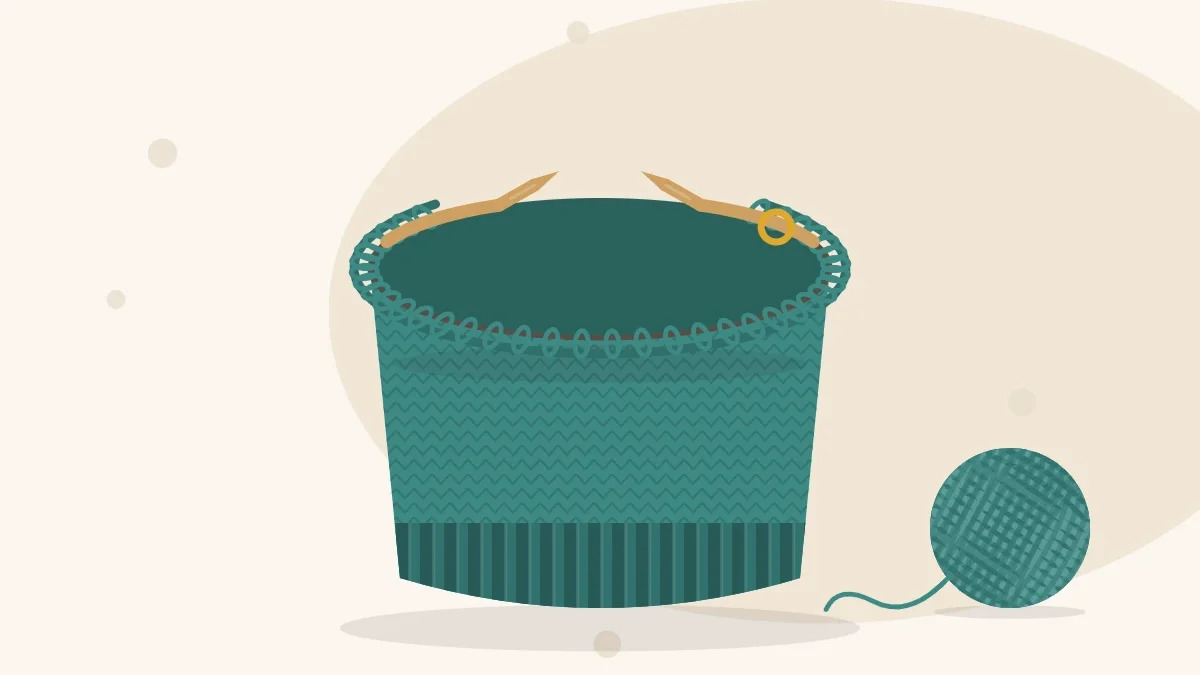
To knit a hat on circular needles, cast on, join the stitches into a ring and knit around and around; the fabric grows as a seamless tube. There is no purling in the body and no sewing at the end. This pattern is written for a first attempt: plain knit 1, purl 1 ribbing, a stockinette body and a crown steered by stitch markers, so there is very little counting.
What you need
- Yarn: worsted weight (4) wool or wool blend, about 130 (160, 190) yd / 119 (146, 174) m. These are estimates; buy a little extra.
- Needles: US 6 (4 mm) 16-inch (40 cm) circular needle for the brim; US 8 (5 mm) 16-inch (40 cm) circular needle for the body; a set of US 8 (5 mm) double-pointed needles (DPNs) for the top of the crown.
- Notions: 8 stitch markers, one of them a different color to mark the beginning of the round; tapestry needle; scissors; tape measure.
A 16-inch circular is the standard length for adult hats because the stitches reach comfortably around it. Other options, including one long needle for the whole hat, are compared in needles for knitting hats. Metric and US sizes are matched in the Craft Yarn Council’s needle size chart.
Gauge and finished sizes
Gauge: 18 stitches and 24 rounds = 4 in (10 cm) in stockinette stitch worked in the round on US 8 (5 mm) needles, or 4.5 stitches per inch.
Sizes are given as small (medium, large). Where only one number appears, it applies to all sizes.
| Small | Medium | Large | |
|---|---|---|---|
| Cast on | 80 sts | 88 sts | 96 sts |
| Finished circumference | About 17.75 in (45 cm) | About 19.5 in (49.5 cm) | About 21.25 in (54 cm) |
| Finished height | About 7.75 in (19.5 cm) | About 8.5 in (21.5 cm) | About 9 in (23 cm) |
| Fits head of about | 19.5 to 20.5 in (49.5 to 52 cm) | 21 to 22.5 in (53 to 57 cm) | 23 to 24 in (58.5 to 61 cm) |
Each circumference is the cast-on number divided by 4.5, and each size is worn with roughly 1.5 to 3 in (4 to 7.5 cm) of negative ease. Head ranges are typical figures only; measure the wearer and check the knit hat size chart if in doubt.
Abbreviations
- CO: cast on
- k: knit
- p: purl
- k2tog: knit 2 stitches together (1 stitch decreased)
- pm: place marker
- sm: slip marker from the left needle tip to the right
- BOR: beginning of round
- rnd: round
- st/sts: stitch/stitches
All are standard terms from the Craft Yarn Council’s knitting abbreviations list.
The pattern
Cast on and join
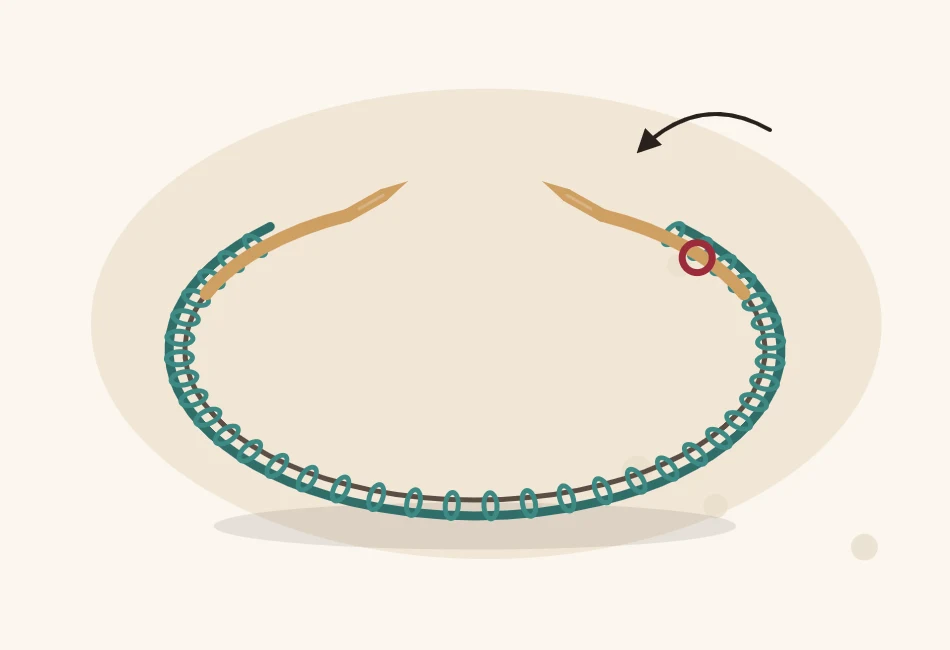
With the US 6 (4 mm) circular needle, CO 80 (88, 96) sts. Spread the stitches around the needle and lay it on a table. Check that the cast-on edge runs along the inside of the ring all the way around, with no part of it flipped over the needle. Place the BOR marker on the right needle tip, then knit the first cast-on stitch from the left tip, pulling the yarn snug. The ring is now joined.
Watch out
A twist in the cast-on cannot be fixed once a few rounds are knit; the only cure is to start again. Check before joining and again after the first round. The guide to joining in the round without twisting shows what to look for.
Brim
Ribbing rnd: (K1, p1) around to the BOR marker, sm.
The first stitch knit during the join counts as the first k1. Repeat the ribbing round until the brim measures 1.5 in (4 cm) from the cast-on edge.
Body
Change to the US 8 (5 mm) circular needle by knitting the next round onto it; the smaller needle empties as you go.
Body rnd: Knit all stitches, sm.
Repeat the body round until the hat measures 5 (5.25, 5.5) in / 12.5 (13.5, 14) cm from the cast-on edge.
Crown
The crown has 8 equal sections. Markers do the counting.
Set-up rnd: (K10 (11, 12), pm) 8 times, using the BOR marker already in place as the eighth marker. Each section holds 10 (11, 12) sts.
Decrease rnd: (Knit to 2 sts before the next marker, k2tog, sm) 8 times — 8 sts decreased.
Plain rnd: Knit all stitches, slipping the markers.
Repeat the decrease round and the plain round, checking the count against the table. Work the decrease round 9 (10, 11) times in total and do not work a plain round after the last one.
| After decrease rnd | Small | Medium | Large |
|---|---|---|---|
| 1 | 72 sts | 80 sts | 88 sts |
| 2 | 64 sts | 72 sts | 80 sts |
| 3 | 56 sts | 64 sts | 72 sts |
| 4 | 48 sts | 56 sts | 64 sts |
| 5 | 40 sts | 48 sts | 56 sts |
| 6 | 32 sts | 40 sts | 48 sts |
| 7 | 24 sts | 32 sts | 40 sts |
| 8 | 16 sts | 24 sts | 32 sts |
| 9 | 8 sts (finished) | 16 sts | 24 sts |
| 10 | 8 sts (finished) | 16 sts | |
| 11 | 8 sts (finished) |
On the final decrease round each section has only 2 stitches left, so the round is simply k2tog 8 times. The crown takes 17 (19, 21) rounds, about 2.75 (3.25, 3.5) in / 7 (8, 9) cm.
Changing to double-pointed needles
When the stitches no longer stretch around the circular needle, usually at about 48 to 56 stitches, move to the DPNs. On the next round, knit the stitches of two or three sections onto each of three DPNs, keeping the markers in place, and use a fourth DPN to knit.
Tip
Pull the yarn a little firmer on the first two stitches of each DPN. This closes the loose column, often called a ladder, that can form where one needle hands over to the next.
Finishing
- Cut the yarn, leaving a tail of about 8 in (20 cm), and thread it onto the tapestry needle.
- Pass the needle through the 8 remaining stitches in the order they would be knit, removing the markers and slipping the stitches off the DPNs.
- Go around the 8 stitches a second time for strength, pull the tail firmly to close the hole and take it to the inside through the center.
- Weave in both tails on the wrong side.
Blocking evens out the stitches and settles the crown; see how to finish a knit hat for the steps.
Ways to adjust it
- Folded cuff: work the ribbing for 4 in (10 cm) and knit the body until the hat measures 7 (7.25, 7.5) in / 18 (18.5, 19) cm from the cast-on edge before the crown. Folded up 2 in (5 cm), the hat keeps its listed height. Allow roughly 30 yd (27 m) more yarn.
- A rounder or flatter top: working plain rounds between every decrease round gives a gently rounded crown. Leaving out the plain rounds once about 40 stitches remain flattens the very top. The reasoning is explained in crown decreases.
Frequently asked questions
What length circular needle do I need for a hat?
A 16-inch (40 cm) circular suits most child and adult hats because the stitches reach around it without stretching. The top of the crown needs double-pointed needles or a long circular used for magic loop.
Why do I need double-pointed needles as well?
As the crown decreases, there are too few stitches to reach around a 16-inch needle. At roughly 48 to 56 stitches in worsted yarn, the stitches are moved to double-pointed needles to finish the last rounds.
Do I purl when knitting stockinette in the round?
No. Because the right side always faces the knitter, knitting every round produces stockinette. Purl stitches appear only in the ribbed brim.
What if my stitch count is wrong after a decrease round?
Count each of the 8 sections between markers. They should all hold the same number of stitches. A section with one extra stitch is where a decrease was missed; work a k2tog there on the next round.